
Fear of Brazil is a 100-year tradition. So is building here.
2,477% inflation, a coup, a savings freeze, 9 currencies, 2 dictatorships, 2 impeachments. And empires kept being built.
The market is worried, discouraged, and full of doubts. Fundraising is stalled, valuations are falling, and good people are heading for the airport. The election is over, and the question has surfaced: does Brazil still make sense?
Whenever I read the biography of someone who built an empire in Brazil, I go straight to the same chapter: the moment they decided to start. And what strikes me is that it was rarely a good time. Whether it was 1943, in the middle of a world war; 1971, under a military dictatorship; or 1989, with inflation approaching 2,000% a year.
The people below weren't optimists. They simply understood one rule of the game early on: in Brazil, if you wait for conditions to improve before getting started, you'll never get started.
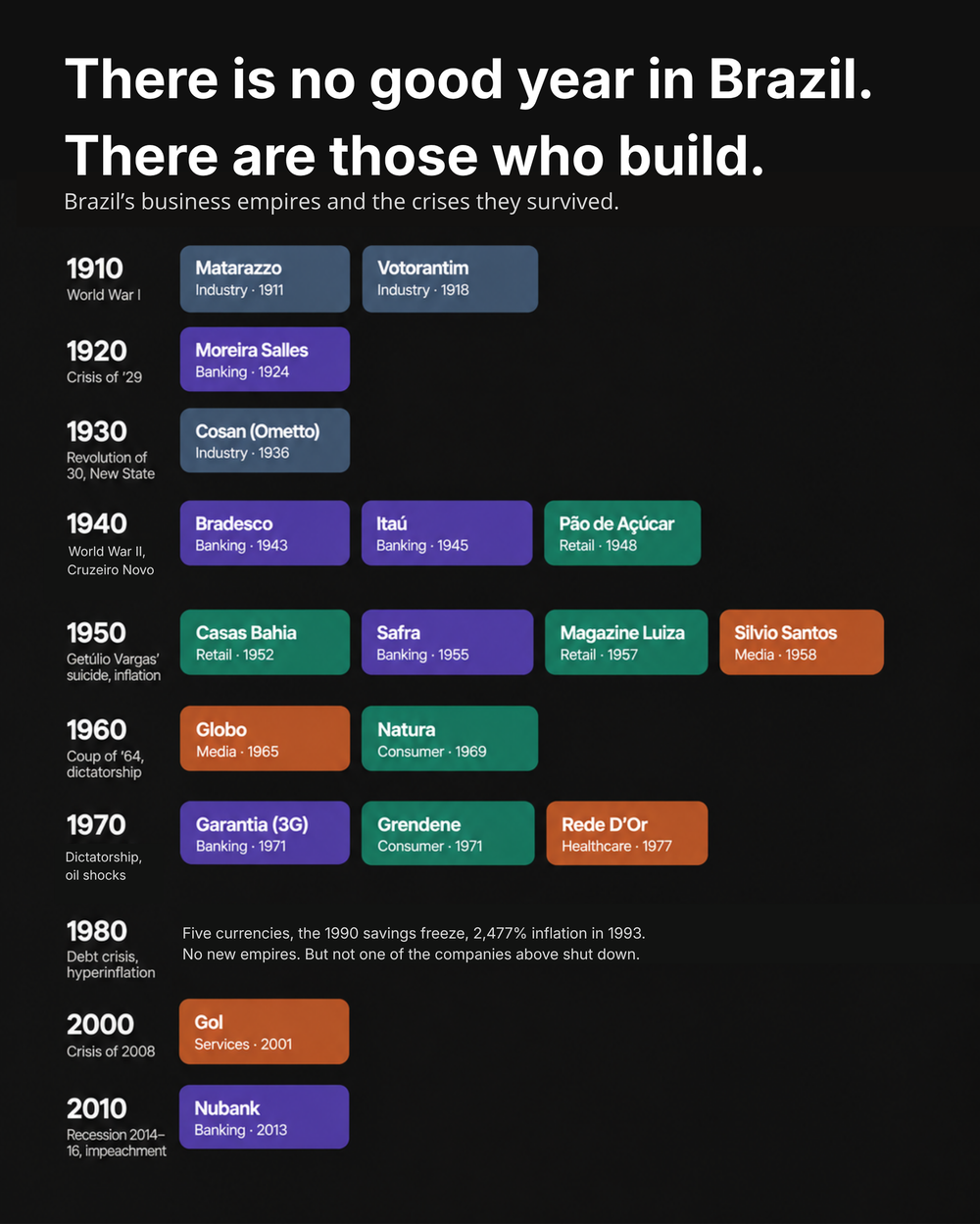
Look at what this country has been through over the past 100 years: two dictatorships, nine currencies, frozen savings, 2,477% inflation, two impeachments. This isn't a country that has experienced crises. It's a country where crisis is the norm and stability is the exception.
And yet.
Amador Aguiar, the son of a farmworker, opened Bradesco in Marília in 1943, in the middle of World War II, to bring banking services to the country's interior, a market no one else wanted to serve.
Samuel Klein survived a concentration camp, arrived in Brazil in 1952 selling bed linens door to door, and built Casas Bahia by extending credit to people no bank would serve.
Lemann, Telles, and Sicupira founded Garantia in 1971, at the height of the military dictatorship, and bought Brahma in 1989, with inflation approaching 2,000% a year. That was the beginning of what would become the world's largest brewing company.
David Vélez isn't Brazilian and could have built a company anywhere. He chose Brazil in 2013, on the eve of the country's worst recession in recent history, and built Nubank.